How Daily Structure Shapes Long-Term Health
How Daily Structure Shapes Long-Term Health
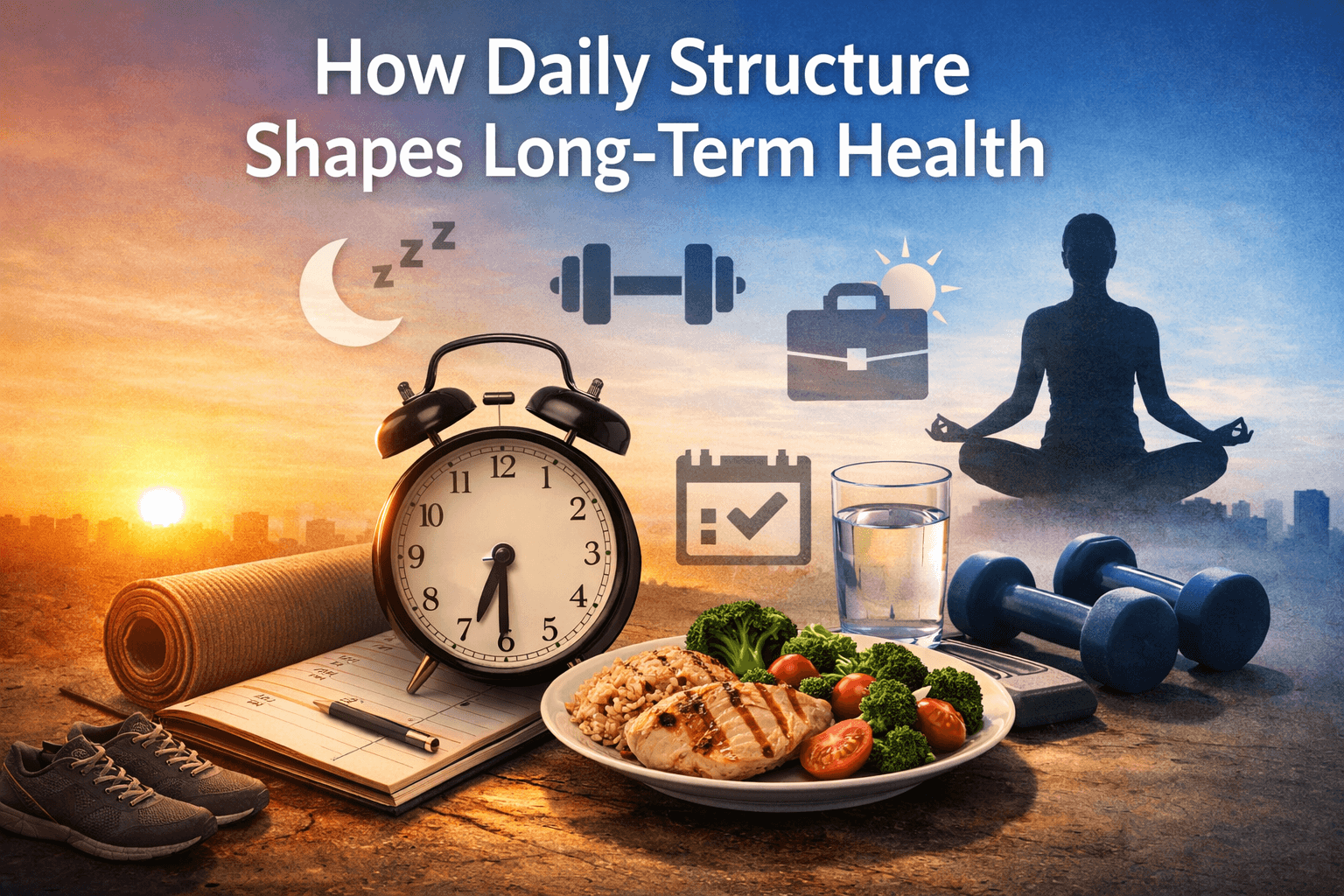
A practical look at how routines around sleep, movement and work affect energy levels and consistency over time and why small adjustments tend to outperform radical changes.
A practical look at how routines around sleep, movement and work affect energy levels and consistency over time and why small adjustments tend to outperform radical changes.
A practical look at how routines around sleep, movement and work affect energy levels and consistency over time and why small adjustments tend to outperform radical changes.
In this post:
In this post:
In this post:
Section
Section
Section
Daily structure is often discussed in abstract terms, but its effects are cumulative and measurable over time. Sleep schedules, meal timing, movement patterns and work rhythms shape how energy is distributed across the day, not just how productive a person feels in a single moment. When these elements follow no consistent pattern, the body and mind are forced into constant adjustment, which increases fatigue even if total effort remains the same. Over long periods, this lack of predictability tends to reduce adherence to otherwise reasonable habits, because maintaining them requires more conscious effort.
Small, repeatable routines reduce the number of decisions required throughout the day. Waking at similar times, eating within a predictable window, or assigning fixed periods to focused work creates a baseline that the body adapts to. Once adaptation occurs, energy expenditure shifts from regulation to execution. This is why minor adjustments, such as moving bedtime earlier by thirty minutes or introducing short, regular movement instead of occasional intense sessions, often produce more stable outcomes than dramatic overhauls that are difficult to maintain.
Work structure plays a similar role. Irregular schedules, constant context switching, and undefined stopping points increase mental load, even if total working hours remain unchanged. Over time, this contributes to inconsistency in sleep, nutrition and recovery, creating feedback loops that degrade overall health. In contrast, bounded work periods and predictable transitions allow recovery to happen naturally, without relying on willpower or external discipline.
Long-term health is less influenced by isolated actions than by the systems that support them. Daily structure acts as an invisible framework that either lowers or raises the cost of maintaining habits. When the framework is stable, small changes compound quietly. When it is unstable, even well-intentioned efforts tend to erode. Understanding this dynamic shifts focus away from intensity and toward repeatability, which is where sustainable outcomes are usually found.
Daily structure is often discussed in abstract terms, but its effects are cumulative and measurable over time. Sleep schedules, meal timing, movement patterns and work rhythms shape how energy is distributed across the day, not just how productive a person feels in a single moment. When these elements follow no consistent pattern, the body and mind are forced into constant adjustment, which increases fatigue even if total effort remains the same. Over long periods, this lack of predictability tends to reduce adherence to otherwise reasonable habits, because maintaining them requires more conscious effort.
Small, repeatable routines reduce the number of decisions required throughout the day. Waking at similar times, eating within a predictable window, or assigning fixed periods to focused work creates a baseline that the body adapts to. Once adaptation occurs, energy expenditure shifts from regulation to execution. This is why minor adjustments, such as moving bedtime earlier by thirty minutes or introducing short, regular movement instead of occasional intense sessions, often produce more stable outcomes than dramatic overhauls that are difficult to maintain.
Work structure plays a similar role. Irregular schedules, constant context switching, and undefined stopping points increase mental load, even if total working hours remain unchanged. Over time, this contributes to inconsistency in sleep, nutrition and recovery, creating feedback loops that degrade overall health. In contrast, bounded work periods and predictable transitions allow recovery to happen naturally, without relying on willpower or external discipline.
Long-term health is less influenced by isolated actions than by the systems that support them. Daily structure acts as an invisible framework that either lowers or raises the cost of maintaining habits. When the framework is stable, small changes compound quietly. When it is unstable, even well-intentioned efforts tend to erode. Understanding this dynamic shifts focus away from intensity and toward repeatability, which is where sustainable outcomes are usually found.
Daily structure is often discussed in abstract terms, but its effects are cumulative and measurable over time. Sleep schedules, meal timing, movement patterns and work rhythms shape how energy is distributed across the day, not just how productive a person feels in a single moment. When these elements follow no consistent pattern, the body and mind are forced into constant adjustment, which increases fatigue even if total effort remains the same. Over long periods, this lack of predictability tends to reduce adherence to otherwise reasonable habits, because maintaining them requires more conscious effort.
Small, repeatable routines reduce the number of decisions required throughout the day. Waking at similar times, eating within a predictable window, or assigning fixed periods to focused work creates a baseline that the body adapts to. Once adaptation occurs, energy expenditure shifts from regulation to execution. This is why minor adjustments, such as moving bedtime earlier by thirty minutes or introducing short, regular movement instead of occasional intense sessions, often produce more stable outcomes than dramatic overhauls that are difficult to maintain.
Work structure plays a similar role. Irregular schedules, constant context switching, and undefined stopping points increase mental load, even if total working hours remain unchanged. Over time, this contributes to inconsistency in sleep, nutrition and recovery, creating feedback loops that degrade overall health. In contrast, bounded work periods and predictable transitions allow recovery to happen naturally, without relying on willpower or external discipline.
Long-term health is less influenced by isolated actions than by the systems that support them. Daily structure acts as an invisible framework that either lowers or raises the cost of maintaining habits. When the framework is stable, small changes compound quietly. When it is unstable, even well-intentioned efforts tend to erode. Understanding this dynamic shifts focus away from intensity and toward repeatability, which is where sustainable outcomes are usually found.